Dashcam, Drone & Road Trip Gear
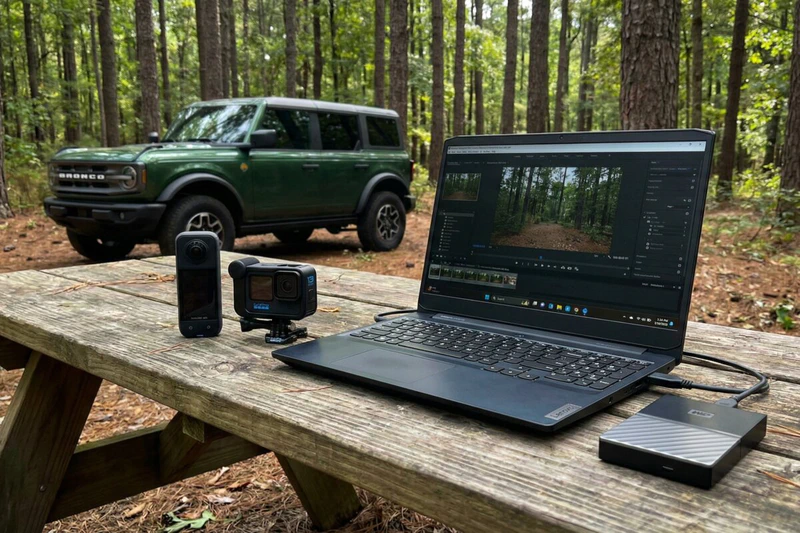
Everything listed here is gear we use for GoMoveShift content — dashcam footage, drone shots, and road trip documentation. The setup prioritizes simplicity and reliability on multi-day road trips where recharging and storage happen in the vehicle.
Transparency Note: As an Amazon Associate I earn from qualifying purchases. Using these links helps support the channel at no extra cost to you.
Cameras & Lenses
The GoPro HERO13 is the primary dashcam — it’s what’s mounted for driving footage on our 2026 routes. The switch from the Insta360 X5 came down to three things: less post-processing (no 360 reframing needed), integrated GPS for route metadata, and standard file formats that feed directly into the editing timeline. The GoPro’s GPS data feeds directly into the GPX track files published on the site, so the route maps and downloadable tracks come straight from the camera that shot the video.
The GoPro has handled mountain driving conditions without issues — no problems with glare, vibration on rough pavement, or temperature swings between valley floors and ridgeline passes. Power management has evolved: we started with battery swaps at stops, but now the GoPro runs wired to vehicle power full-time through the 12V-to-USB-C converter (listed in the vehicle section below). The pass-through battery door keeps the camera sealed while the power cable runs in.
The Insta360 X5 shot all of our published journey footage — every Ireland road trip and the Rockies 2025 were captured on the Insta360. It’s still in the kit for 360 footage when the situation calls for it. We typically run one camera at a time. ND filters (ND8/16/32 and CPL) cut windshield glare in bright conditions — essential on south-facing mountain roads in direct sun.
- Action Camera (Insta360 X5 Bundle)
- GoPro HERO13 Bundle
- Web Cam (Reolink 4K PoE)
- Lens Kit (Insta360 X5)
- ND Filters (GoPro ND8/16/32/CPL)
Mounts, Audio & Accessories
The camera mounting setup has shifted from the suction cup windshield mount to the hood mounts on the Bronco and Jeep. The suction cup was reliable — never had problems with it — but the hood mounts give a lower angle and a more stable platform for driving footage. The suction cup and SmallRig magic arm are still in the kit for windshield and adjustable interior positioning. The magnetic neck mount is for walkabout footage at stops.
The Purple Panda mic captures ambient road and engine sound alongside the dashcam video. The Samsung 1TB microSD cards are the primary recording media — we carry multiple cards and rotate them during multi-day trips rather than relying on a single card. Safety tethers back up every mount — cheap insurance on mountain backroads.
- Suction Cup Car Mount
- Magnetic Neck Mount
- Magic Arm Mount
- SmallRig Hot Shoe Mount
- Audio (Purple Panda Mic)
- Batteries (Insta360 Fast Hub)
- Weatherproof Charging Cover
- MicroSD Card (Samsung 1TB)
- Camera Safety Tethers
- GoPro Battery Door (Pass-through)
Drone Gear
The DJI Air 3 is in the kit for aerial footage, but it rarely flies. Between weather conditions, airspace restrictions, and the logistics of setting up on a road trip, the drone stays in the case on most drives. When it does go up, the anti-collision strobe is FAA-required for twilight flights. The waterproof hard case keeps it protected in the vehicle.
Vehicle & Camping Setup (Ford Bronco)
Ford Bronco and 2-door Jeep Wrangler — both used for road trips. The Bronco is the multi-day vehicle — the air mattress fits in the back for overnight stops, and the 12V fridge keeps drinks and food cold without needing to stop. We slept in the Bronco on the Rockies 2025 road trip and it worked well for the 19-day run. Both vehicles have enough ground clearance for forest service roads and unpaved backroads.
The hood camera mounts (Bronco-specific and Jeep/Gladiator) put the GoPro at hood level for a lower driving perspective than the windshield mount. The 12V-to-USB-C converter keeps the camera powered from the vehicle’s electrical system on long drives without draining camera batteries.
- 12V Refrigerator (BougeRV)
- SUV Air Mattress
- Roof Rack Cross Bars
- Trunk Storage Organizers
- Interior LED Dome Lights
- Rear Ceiling Lights
- Bronco Hood Camera Mount
- Jeep/Gladiator Hood Mount
- Moto Windshield Mount
- 12V to 5V USB-C Converter
Editing & Storage Workflow
Editing in DaVinci Resolve on the Lenovo IdeaPad Gaming 3. The editing is minimal — the footage is meant to be unfiltered, so post-production is mostly cutting, trimming, and basic color correction. No narration, no music overlays, no heavy grading. The point is to show the road as it actually looked.
The 6TB WD portable is the working drive that travels with the laptop — footage gets offloaded from the microSD cards to the portable drive. The 14TB Seagate is archive storage at home. The hard drive case protects the portable drive in the vehicle between editing sessions.
- Laptop (Lenovo IdeaPad Gaming 3)
- 14TB External Drive (Seagate)
- 6TB Portable Drive (WD)
- Hard Drive Protective Case
- USB-C Card Reader
See this gear in action on our Western North Carolina scenic drives and road trip journeys.